Originally reported by The Paper on November 17, 2026. The underlying study by Wang Yaning of Nankai University first appeared in the October 2026 issue of the Journal of the National Museum of China.
After Communist forces took control of Tianjin on January 15, 1949, the city began replacing the previous district, bao and jia administrative system. Wang’s study, based on Tianjin archival records, traces how the new district and street-level arrangements were repeatedly revised through 1952.
The first framework placed streets beneath districts and introduced smaller neighborhood units. Staffing was a problem from the outset: a February 1949 table cited in the study recorded 305 street offices established out of 318 planned, but only 27 of those established had their full complement of staff. The new administration temporarily retained some personnel from the previous system while training new street-level workers.

In April 1949, Liu Shaoqi argued during a visit to Tianjin that city administration should be more concentrated than the rural model the city had initially adopted. A reorganization announced that June made district offices branches of the municipal government and abolished street offices, folding their work into police stations. According to Wang, this left the municipal government handling too many local matters while district offices lacked authority to resolve them.
Tianjin began strengthening district offices in July 1949 and expanded their functions again in July 1950. It also moved toward restoring street offices and establishing residents’ committees. A 1950 plan to rename district offices as district governments was proposed for a trial in three districts; the study does not present that proposal as a citywide change already in force.
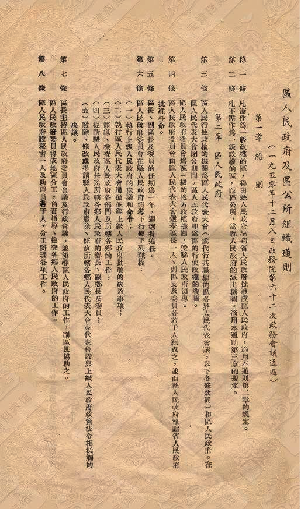
The arrangements took further shape in October 1952. An October 11 provisional measure provided for street offices beneath district governments, while a trial measure on residents’ committees received approval in principle. An October 22 draft decision set out the proposed change from district offices to district governments. Wang interprets the sequence as an effort to balance unified municipal direction with responsibility for work at district and street level.
Source: m.thepaper.cn (originally published 2026-11-17 07:25 UTC+8)