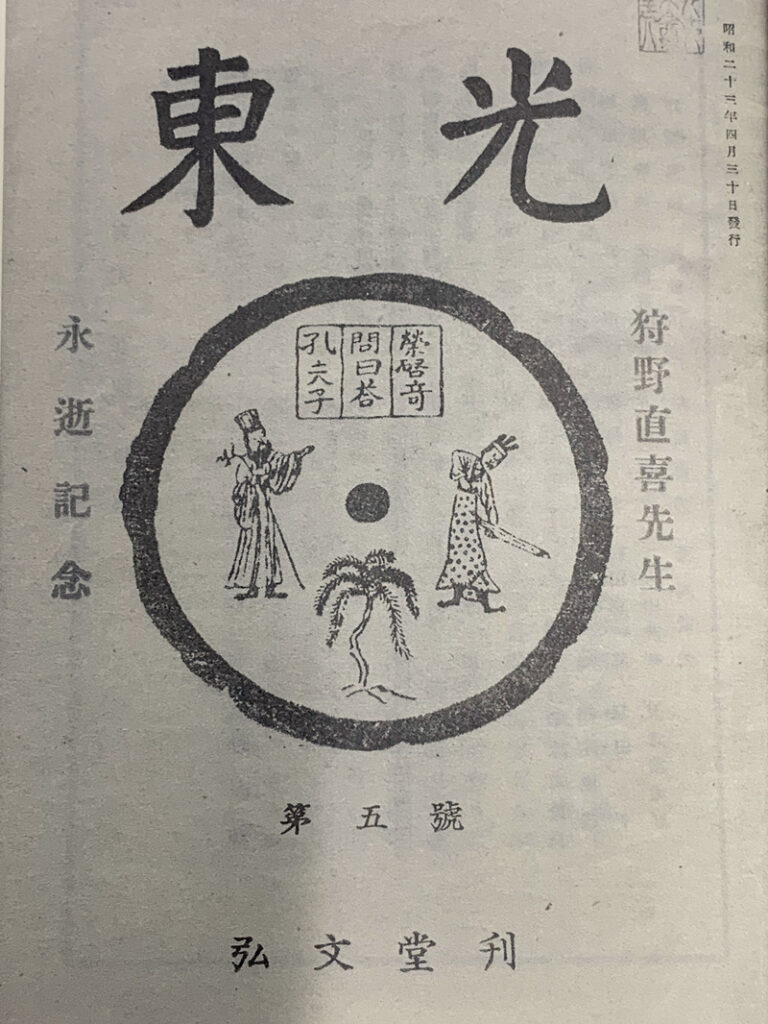
When Yoshikawa Kōjirō first visited Kanō Naoki in February 1923, he was still a secondary-school student hoping to study Chinese literature at university. Kanō asked him to consider two versions of a line of poetry: what changed if the poet saw the southern mountain rather than looked toward it? To understand the difference a single character made, Kanō told him, was to understand something of literature. Years later, during his final illness, Kanō twice returned to the meaning of the character for “die” in a passage from the Records of the Grand Historian. As Yoshikawa remembered it, his education with Kanō began and ended with a lesson in one character.
Yoshikawa told that story in the fifth issue of Tōkō, published by Kōbundō on April 30, 1948, after Kanō’s death on December 13, 1947. Kanō had helped establish Chinese studies at Kyoto Imperial University alongside Naitō Konan and Kuwabara Jitsuzō. Yet he published only two books in his lifetime; most of his other works available to later readers were compiled from lectures. The memorial issue preserves something those texts could not: accounts of what it was like to sit in his classroom, and of what his students did with the lessons they took away.
From newspaper clippings to Yuan drama
Kojima Yūma encountered Kanō in 1905, before Kyoto Imperial University had a college of letters. Then a law student, Kojima enrolled with a friend in afternoon Chinese classes at a language school in Kyoto. Most of their roughly 20 classmates were shop clerks; the two friends were the only university students. Kanō brought newspaper clippings and the texts of treaties to teach contemporary written Chinese. Kojima remembered the clarity of his explanations and the pleasure of finally understanding passages that had puzzled him. After completing his law degree, he went on to graduate from the same university in Eastern philosophy, with Kanō as his teacher.
In 1906, Kanō became a professor in the university’s new college of letters, teaching Chinese language and literature as well as the history of Chinese philosophy. His seminars could take students through classical ritual texts or an anthology of Yuan plays. Aoki Masaru, who went on to specialize in Chinese drama, recalled studying Autumn in the Han Palace and The Injustice to Dou E in Kanō’s survey of theater history in 1910. According to Aoki, Kanō taught Yuan plays every year thereafter until his retirement in 1928.
For the historian Miyazaki Ichisada, it was a course on Qing institutions and literature that mattered most. Its one-hour weekly meeting generated what felt to him like two hours’ worth of notes. Kanō taught that institutions were the accumulated product of history. Miyazaki credited the course with giving him the idea of citing the satirical novel The Scholars in his own book on China’s civil service examinations.
Reading across traditions
In a 2002 essay on Kanō, the scholar Takata Tokio traced the different kinds of training behind that range. Born on February 11, 1868, the first year of the Meiji era, Kanō attended a school in Kumamoto that combined Confucian learning with fencing, military drill and instruction in Chinese and Korean. At Tokyo Imperial University, he took Shimada Kōson as a scholarly model and learned the Qing tradition of testing interpretations against textual evidence.
Study in China widened his circle of teachers and colleagues. Kanō arrived in Beijing in April 1900 on a Japanese education ministry scholarship and lived through the two-month siege during the Boxer uprising. In August 1901 he returned to China, this time to Shanghai. There he read European scholarship on Asia, met the scholar Joseph Edkins and was introduced to Luo Zhenyu. He also got to know Naitō, then a newspaper journalist. The two visited the Tianyi Pavilion library in Ningbo together.
Those connections later helped make Kyoto a center for the study of manuscripts from Dunhuang. After manuscripts brought back by Paul Pelliot went on display in Beijing, Kanō and other Kyoto scholars traveled there to examine them. Luo and Wang Guowei subsequently took refuge in Kyoto, strengthening local interest in the material. Kanō was among the early scholars to recognize the literary importance of the vernacular narratives known as bianwen. His research extended to drama and fiction, fields in which Wang was also a pioneer. When Kanō left for Europe in 1912, Wang sent him off with a poem honoring him as a leading Confucian scholar. In 1973, Yoshikawa suggested that Wang may have been Kanō’s closest intellectual friend.
What the tributes leave open
The contributors did not all see the same man. Aoki remembered mistaking the short figure in a worn Western suit for a university employee, only to watch him take the lectern as the professor of Chinese literary history. Kanō’s colleague Takase Takejirō recalled a calligrapher who copied the Qing master Liu Yong and a trained singer with a strong voice for Noh chant. For the student Kuraishi Takeshirō, a defining moment came at Kōfukuji temple in Nara: a project to photograph one manuscript unexpectedly turned up another, and Kanō could scarcely contain his delight. Kuraishi’s judgment was that research was almost a sideline for his teacher. Reading itself was his principal occupation.
The tributes say less about Kanō’s politics. His school in Kumamoto had promoted loyalty to the emperor; decades later, he helped plan a Japanese cultural program in China financed with Boxer indemnity funds. He joined its investigative committee in 1923 and became director of its Kyoto research institute in 1929. Takata regarded that institutional work as the most significant undertaking of Kanō’s later years. How far his early schooling shaped his political outlook, and why his sympathies lay with the Qing rather than the new Chinese republic, remain open questions. On a different question, the memorialists offer unusually precise evidence: decades after a class ended, a student could still name the play, the novel or the single verb that had changed how he read.