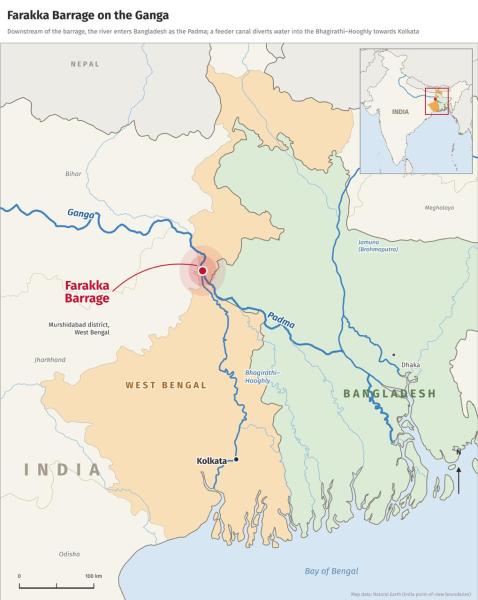
The Ganga Water Treaty is due to expire on December 12, 2026. Of the 54 rivers India and Bangladesh share, the Ganga is the only one covered by a comprehensive water-sharing treaty. The two governments can renew the 1996 pact by mutual consent, but as of November 28 they had announced no agreement. A central question is one earlier negotiators also faced: when the river runs low, how much water can Bangladesh count on receiving downstream?
How a port upstream of the sea became a diplomatic issue
Just beyond Farakka in West Bengal, the Ganga divides. The Padma flows east into Bangladesh, while the Bhagirathi turns south through West Bengal. After the Jalangi joins it, the southern branch is known as the Hooghly, the river on which Kolkata’s port depends.
In the 1850s, British engineer Arthur Cotton proposed diverting Ganga water through a canal to flush silt from the Hooghly. Ships had particular difficulty reaching the port during the January–May dry season, when there was less water to carry sediment away. India began building the Farakka Barrage in 1961, about 18 kilometres from the border with what was then East Pakistan. The diversion began in 1975, four years after Bangladesh became independent.
On the Bangladeshi side, those same dry months were precisely when water diverted from the Padma was most keenly contested. In 1976, Maulana Abdul Hamid Khan Bhashani led the Farakka Long March to demand the barrage’s demolition. He argued that it was drying up the Padma and causing desertification.
A guarantee that did not survive earlier agreements
After a temporary, 41-day arrangement in 1975, the countries signed a five-year accord in 1977. According to Salman M. A. Salman’s account in a 1998 World Bank publication, it allocated Bangladesh about 59% of the available dry-season water and India about 41%. Crucially, Bangladesh was guaranteed at least 80% of its scheduled share in each 10-day period, however low the actual flow. Agreements in 1982 and 1985 broadly retained the allocation formula but dropped that safeguard.
In 1996, Indian Prime Minister H D Deve Gowda and Bangladeshi Prime Minister Sheikh Hasina signed a 30-year treaty. It recognised Bangladesh’s rights downstream and established a joint committee, with equal representation from both governments, to oversee implementation. Disputes the committee could not resolve would go to the Joint Rivers Commission, which the countries had established in 1972.
What the 1996 treaty does when water is scarce
The treaty uses 10-day periods during the dry season and draws on flow records from 1949 to 1988. The allocation depends on the flow at Farakka, measured in cubic feet per second, or cusecs:
- 70,000 cusecs or less: India and Bangladesh divide the flow equally.
- Between 70,000 and 75,000 cusecs: Bangladesh receives 35,000 cusecs and India takes the rest.
- 75,000 cusecs or more: India receives 40,000 cusecs and Bangladesh takes the rest.
From March 11 to May 10, the countries take turns receiving a guaranteed 35,000 cusecs, each for three of the six 10-day periods. That limited guarantee is different from a minimum that Bangladesh can rely on throughout the dry season. If flow falls below 50,000 cusecs in any 10-day period, the treaty requires immediate consultations rather than prescribing an emergency allocation.
What remains unsettled
According to Bangladeshi media reports, Water Resources Minister Shahiduddin Chowdhury Anee said his government wanted a new treaty, not simply an extension, with a guarantee for Bangladesh’s dry-season share. Dhaka also wants updated flow data and a right-to-information provision. It argues that the Farakka diversion has caused severe shortages downstream and that the historical records behind the formula no longer reflect the river’s behaviour as the climate changes.
India favours allocations tied to the water actually available and is considering a shorter term, while Bangladesh seeks longer-term certainty. Nilanjan Ghosh, head of Development Studies at the Observer Research Foundation, argued that a fixed volume payable regardless of flow would leave India bearing a disproportionate share of shortages. Within India, Janata Dal (United) leaders oppose renewal, blaming the barrage for worsening floods in Bihar. Former Bihar chief minister Nitish Kumar argued that accumulated silt was raising the riverbed and increasing the risk of overflow during heavy rain. Indian External Affairs Minister S Jaishankar has said Bihar’s interests will be considered.
The dispute over Dhaka’s request for Hasina’s extradition has also cast doubt on a possible late-November visit to India by Bangladeshi Prime Minister Tarique Rahman, at which a renewal announcement had been expected. Technical discussions have continued, according to Indian foreign ministry spokesperson Randhir Jaiswal. A four-member Indian delegation attended the treaty’s 91st Joint Committee session in Bangladesh in November, but renewal was reportedly not on the agenda.