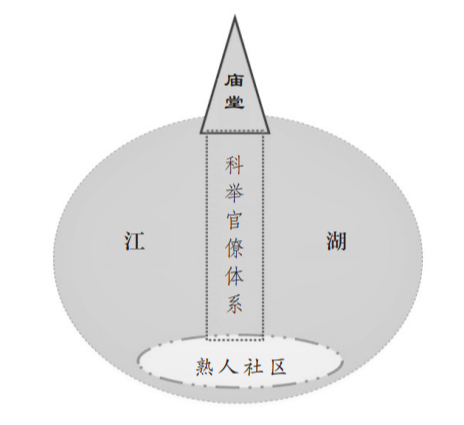
In an essay published on November 19, 2026, historian Li Gongzhong asks how people in premodern China understood the world of relationships beyond family and familiar neighbours. His proposed answer is jianghu: a term that could refer to rivers and lakes, to a life away from the imperial court, or to a less clearly governed space of trade, travel and encounters among strangers.
Li does not present jianghu as an exact equivalent of modern “society.” He uses it as a way to examine what lay between the village and the imperial state. Drawing on sociologist Fei Xiaotong’s account of the village as a network of familiar relationships, Li contrasts its relatively established expectations with the uncertainty of markets, transport routes and other places where people from different communities met. He argues that the limited reach of local government helped shape that wider space.
The essay also treats jianghu as a cultural tradition. Stories of brotherhood in Romance of the Three Kingdoms and Water Margin made its ideals widely recognizable, but Li distinguishes those literary narratives from historical evidence. He turns instead to the surviving manuals of the Tiandihui, or Heaven and Earth Society, which recorded initiation practices, rules and methods of recognition. In his reading, sworn brotherhood offered strangers a way to create ties modelled on family relationships. Loyalty and mutual aid bound members together, though those obligations did not necessarily extend beyond the group.
Li’s broader argument is that jianghu can help connect familiar accounts of imperial institutions, Confucian learning and village life. He suggests it also adds a layer to Fei’s idea of a “differential mode of association,” which describes social ties extending outward from personal relationships. This is an interpretive framework for studying premodern social structure, not a claim that all life outside the village followed a single set of rules.
The essay is excerpted from Li’s How Did Modernity Come About? A Millennium of Change Through the History of Concepts, published by Shanghai People’s Publishing House in September 2026.