In 1952, CBS let I Love Lucy write Lucille Ball’s pregnancy into the story, but executives would not let the characters say “pregnant.” Advertisers wanted Ball’s growing belly kept out of sight, and CBS asked a priest, a minister and a rabbi to review the scripts. When “Lucy Goes to the Hospital” aired, it drew 70 percent of the television audience.
That gap between what broadcasters feared and what viewers would watch runs through decades of television history. But the objections did not always come from the same place. Sometimes a network intervened before an audience ever saw a scene. In other cases, it was viewers who questioned a broadcaster’s judgment, whether it was showing children a slapstick routine or presenting a ghost story as live news.
Who belonged on screen?
Before I Love Lucy had a pregnancy storyline, it had a casting dispute. When CBS approached Ball about adapting her radio comedy My Favorite Husband, she wanted to work with Desi Arnaz, her husband of nearly a decade. Producers resisted. Ball later recalled that people at her talent agency doubted an American audience would believe she was married to a man with a Cuban accent. The marriage they considered implausible was the couple’s own.
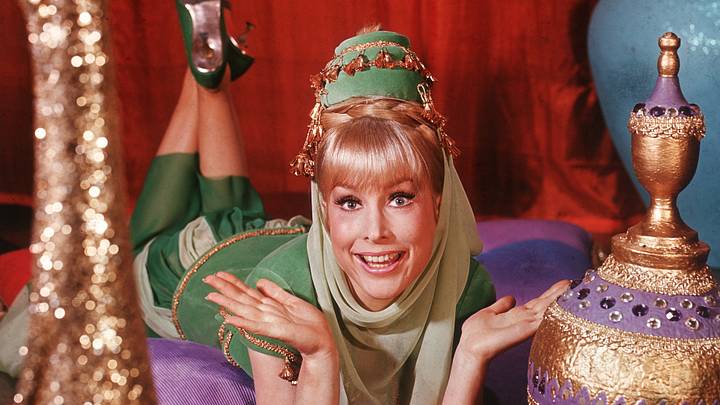
In the 1960s, NBC censors drew a remarkably precise distinction over Barbara Eden’s pink costume on I Dream of Jeannie: her midriff could appear, but not her navel. Star Trek challenged a different convention. Gene Roddenberry gave the Enterprise an international crew, and in the 1968 episode “Plato’s Stepchildren,” Captain Kirk and Lieutenant Uhura shared an interracial kiss, just a year after interracial marriage became legal nationwide in the United States. Mental Floss reports that the episode was banned in several states.
Three decades later, complaints about representation could mean quite different things. In Britain, Russell T Davies’s Queer as Folk followed three gay men in Manchester over eight episodes on Channel 4 in 1999. Its depictions of sex and nudity prompted the Daily Mail to call for censorship. In the United States, The Sopranos, which also debuted in 1999, drew criticism for graphic violence and strong language. Several cultural organizations raised a separate objection throughout its run: they accused the series of stereotyping Italian Americans.
What children might imitate
A change of audience could make familiar material controversial. Tom and Jerry debuted in cinemas in 1940 and appeared in more than 100 MGM theatrical shorts during the 1940s and 1950s. When those films reached Saturday-morning television in the 1960s, American parents objected to their violence. Gene Deitch, who took charge of MGM’s theatrical revival in 1961, had himself described the cartoons as “needlessly violent.”
The Three Stooges faced much the same objection when their shorts entered television syndication in the late 1950s. Parent-teacher groups and the National Association for Better Radio and Television questioned their suitability for children. The comedians responded on air by demonstrating the choreography behind their apparently painful blows.
The distinction between watching and imitating became especially important in 1993. After a five-year-old Ohio boy started a mobile home fire that killed his two-year-old sister, their mother blamed an episode of Beavis and Butt-Head for inspiring him. Her accusation intensified scrutiny of the animated series, but the alleged connection was later questioned. It was not an established explanation for the fire.
When broadcasters intervened
Satire put the BBC in an awkward position in 1962. David Frost’s That Was the Week That Was made fun of politicians, the press and royalty. According to an account of the premiere’s aftermath, angry newspaper editors called Postmaster General Reg Bevins, the minister responsible for broadcasting. Bevins announced that he would act, only to find a note at his office from Prime Minister Harold Macmillan telling him not to. An American version followed in 1964 and ran for 50 episodes.
Sometimes the objections came from inside the broadcaster. Religious groups accused Monty Python’s Flying Circus of blasphemy, but it was a sketch about a cannibalistic mortician that prompted a meeting at which BBC executives condemned the comedy’s cruelty. At NBC in 1975, the prospect of Richard Pryor hosting Saturday Night Live made censors nervous. Producer Lorne Michaels reportedly threatened to leave if Pryor could not host. NBC aired the show on a five-second delay.
Chuck Barris, host of The Gong Show, described a different way of dealing with network scrutiny: booking especially provocative acts in the hope that censors would concentrate on those and overlook the rest. In 1977, the strategy misfired. The “Popsicle Twins” routine made it to air and drew complaints; it was pulled before the West Coast broadcast.
The arguments inside the script
CBS introduced the 1971 premiere of All in the Family with a disclaimer explaining that the target of the humor was prejudice itself. That distinction mattered in a sitcom that addressed racism, homosexuality and the Vietnam War through arguments involving its bigoted patriarch, Archie Bunker. Its spin-off Maude, created by Norman Lear and starring Bea Arthur, brought reproductive decisions into the conversation. A first-season two-parter in which 47-year-old Maude considers an abortion and discusses a vasectomy for her husband drew 7,000 letters of complaint.
On the Korean War comedy M*A*S*H, one dispute concerned not what the characters said but what the audience heard: a compromise with CBS kept the laugh track out of surgical scenes. The word “virgin” was cut even when it described a soldier who had never seen combat. A proposed story implying that Hawkeye was dating two women at once never aired.
ABC encountered resistance before viewers could judge Susan Harris’s soap-opera parody Soap for themselves. In 1977, the network circulated two episodes to affiliate executives, and their adverse reaction reached the press. Religious groups protested reports of a scene involving a Catholic priest in a confessional, and some advertisers withdrew. The series nevertheless ran for four seasons and more than 80 episodes. In 1993, affiliates took a more direct step over the language and nudity in NYPD Blue: a quarter of ABC’s 200 affiliates declined to show the pilot. Its first season went on to earn 26 Emmy nominations.
What viewers thought they were watching
Even a familiar genre could upset expectations. The BBC’s 1976 adaptation of Robert Graves’s 1934 novel I, Claudius told the story of the early Roman Empire through a fictionalized Emperor Claudius, played by Derek Jacobi. The production found an audience despite controversy over its depictions of sex, incest and violence. When EastEnders premiered on February 19, 1985, the shock came within minutes: three residents of London’s fictional Walford forced their way into a neighbor’s flat and found him dying in his armchair. Campaigner Mary Whitehouse condemned the early-evening drama as one of the worst programs the BBC had made.
With Ghostwatch, the question was whether viewers recognized a drama at all. The BBC’s 90-minute Halloween special on October 31, 1992, looked like a live investigation of a haunting in a London home. Familiar broadcasters Michael Parkinson, Sarah Greene and Mike Smith lent it credibility, as did apparent calls from viewers. In fact, the calls were fictional and the drama had been recorded months earlier. The BBC received thousands of complaints, and the special has not been broadcast again in the UK.
The Dutch debut of Big Brother in 1999 posed almost the reverse question. The participants were real; what some viewers found objectionable was the premise of making their daily lives available to a national audience. Some 10,000 people applied for that first series. As with Lucy’s pregnancy nearly half a century earlier, a public argument about what television ought to show was no reliable measure of how many people wanted to take part or tune in.