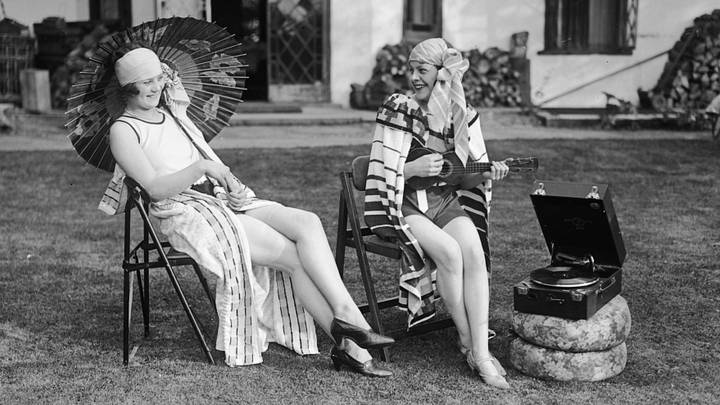
In the 1920s, an American family could hear breaking news on the living-room radio but still depend on an ice delivery to keep food cold. Economic growth after World War I put cars and electric appliances within reach of more households, but the changes were uneven. By the middle of the decade, most families had a record player. Most still did their laundry by hand.
Music in the parlor, news in the living room
A hand-cranked phonograph, often kept in a parlor cabinet or case, let families choose what to hear. Thomas Edison had invented his tinfoil phonograph in 1877, and gramophones followed in the late 1880s. By the 1920s, novelty songs were among the biggest hits, and listeners collected recordings by Louis Armstrong and Mamie Smith.
Radio, by contrast, gave distant listeners a common schedule. The United States had just five radio stations in 1921 and 606 by the end of the decade. Families gathered around their sets for favorite programs, fitting broadcasts into mornings, evenings and holidays. News, music and advertising reached even isolated rural communities. Looking back in 1933, E. B. White described radio as a “pervading and somewhat godlike presence.”
The work of keeping food cold and rooms warm
Electric refrigerators existed, but they cost too much for the average family and did not become popular until after World War II. Most families used a wooden icebox with an upper compartment for a block of ice. A delivery worker brought fresh ice several times a week; between deliveries, someone at home had to empty the pan that caught the meltwater.
Most houses lacked central heating and wall insulation. Families used fireplaces, oil or coal heaters, or wood stoves. A wood stove heated a room more effectively than a fireplace, but it needed regular tending and plenty of fuel. Warm clothing still mattered at night, when the fire burned low.
What counted as a clean house
Some wealthy households owned electric washing machines, but for most families, wash day meant scrubbing clothes against a washboard, rinsing and boiling them in separate pots, then hanging them up. In winter, clothes sometimes froze on the line. Ironing often took up the following day.
Vacuum cleaners promised to lighten the work. With domestic servants less common, manufacturers marketed vacuums to middle-class women. Rugs that had once been carried outdoors and beaten once or twice a year could now be cleaned in place. But advertisements also stressed the dangers of dust, raising expectations for how clean a home should be. For many women, the new standard meant more work rather than less.
From the medicine cabinet to the road
One small convenience did away with a step in treating a cut. When Band-Aids appeared in 1920, they came in handmade strips that users had to cut to size. Pre-cut bandages reached stores in 1924 and soon found a place in medicine cabinets alongside such items as aspirin, thermometers and safety razors.
The automobile changed what families could do away from home. Ford’s Model T helped bring car travel within reach of ordinary buyers, and manufacturers including Chrysler and General Motors helped expand the market. As cars shifted from luxuries toward everyday necessities, they opened up opportunities for travel and leisure. Their spread also created manufacturing jobs, contributed to urbanization and changed the food industry.