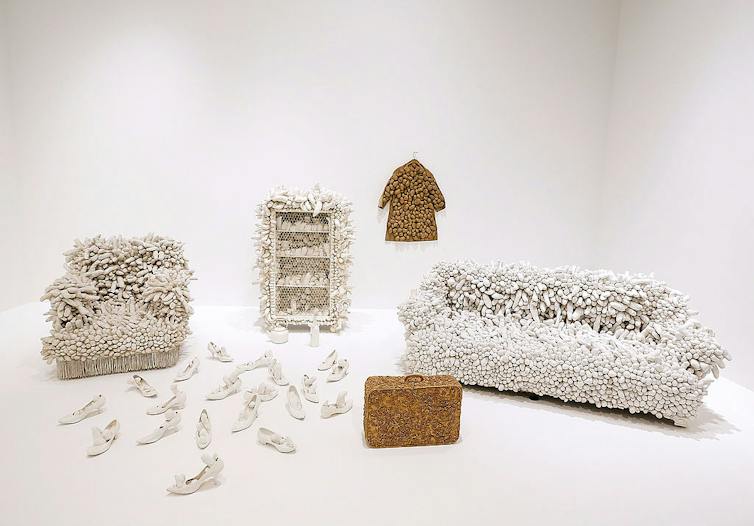
For Accumulation No. 1, Yayoi Kusama covered an armchair with phalluses made from tubes of fabric, stuffed with cotton and painted white. Sewing was a skill she had learned as a girl in Japan. In 1960s New York, art historian Midori Yamamura argues, it gave her a way to mock a symbol of male authority: she could make as many of them as she wanted.
A retrospective at Amsterdam’s Stedelijk Museum, on view through January 17, 2027, brings Kusama’s work back to the museum where she sent two canvases for display on February 5, 1962. Kusama, who died on August 14, 2026, at 97, turned to sculpture soon after sending those paintings. The armchair was the first in her Accumulation series, and its repeated forms helped set the course for her Infinity Mirror Rooms.
Who made the chair?
Critics have often treated repetition in Kusama’s work as evidence of obsessive-compulsive disorder. Yamamura argues that this reading overlooks how deliberately Kusama organized the work. In a 2008 interview with filmmaker Heather Lenz, Kusama’s friend Helen Yrissary, who helped sew the forms, recalled that five assistants made them. Only Kusama attached them to the chair.
Repetition also had a meaning particular to New York art at the time. Some critics saw the sweeping gestures of abstract expressionist painting as marks of an individual struggle for originality, one they understood in masculine terms. Pop artists turned instead to ready-made objects and the repetitions of factory production. Kusama also began with an existing object, but the forms that multiplied across it were the product of a traditionally feminine craft.
In her autobiography, Kusama connected the phallic motif to her exploration of kyōfu, or fear and feelings of the uncanny, drawing on Sigmund Freud’s theories. Yamamura suggests that the Accumulation sculptures may have satirized Freud’s idea of penis envy. The reception of the work illustrates the disparity Kusama faced: The New York Times gave Accumulation No. 1 and Accumulation No. 2 only a brief mention at their debut. Three months later, Claes Oldenburg exhibited his own sewn sculptures to acclaim in art magazines. He acknowledged Kusama’s influence in the 2010s, after she had gained international prominence.
From a piece of furniture to an entire room
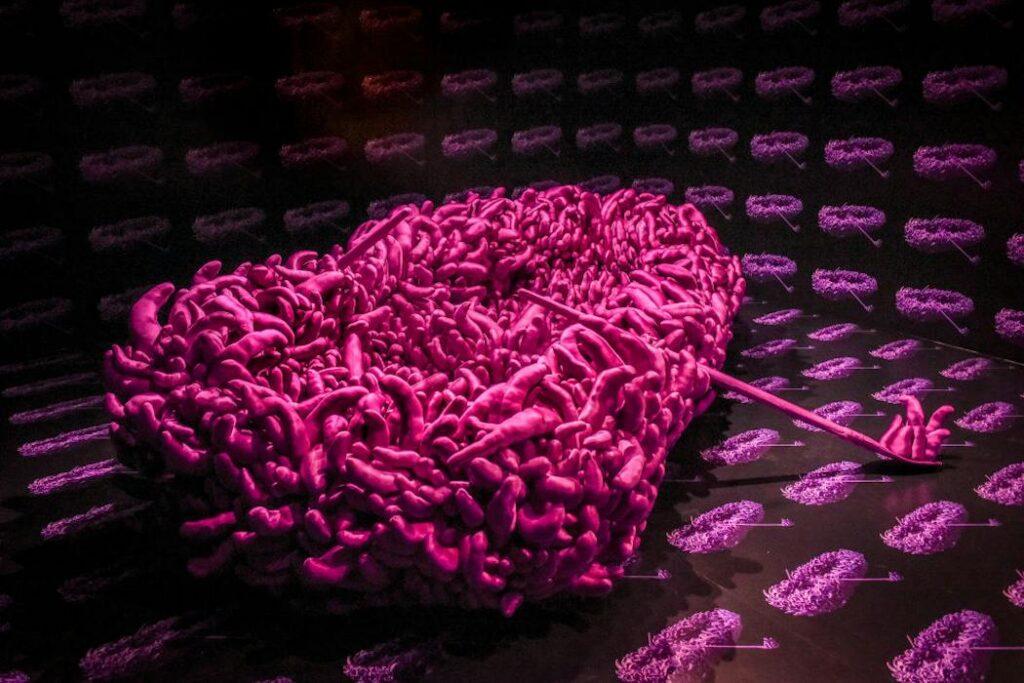
At New York’s Gertrude Stein Gallery, from December 1963 to January 1964, Kusama exhibited a wooden rowboat covered with phallic forms. For Aggregation: One Thousand Boats Show, she repeated an image of the boat across all four walls. With the chair, viewers could stand back and inspect the object. With the boat, even a viewer who turned away from the sculpture faced its image again.
In the 1966 Peep Show at New York’s Castellane Gallery, later known as Love Forever, the repeated form became a point of light. Kusama combined mirror reflections, strobe lights and Beatles music in an attempt to evoke a psychedelic experience without drugs. Yamamura reads that shift as a response to the earlier sculptures: where the phallus had occupied every surface, a dot of light could now command the same space. The pleasure of looking, rather than the authority of the symbol, became the point of the room.