During the English Reformation, calling a monk or clergyman an abbey-lubber was an accusation: he lived in comfort and idleness. A lubber was a foolish or clumsy person, a sense echoed in landlubber. By the late 1500s, according to the Oxford English Dictionary, anyone habitually lazy could be called abbey-lubber-like. Other terms for idleness took less direct routes, starting with a door latch, a horse’s gait or a joke about a dog.
From a thief to a straggler
A medieval draw-latch was a thief who lifted a door latch to enter someone’s home. But latch was also a verb for loosening a horse’s reins and, by extension, for dawdling. Confusion between the two senses changed the insult: by the 1500s, a draw-latch was someone who lagged behind. Draw-latching could mean either falling behind the others or simply idling.
In Scots, kipper-kaper evoked the clomp of hooves. Recorded in the early 1900s, the adjective described a sluggish person; the Dictionary of the Scots Language makes the comparison more precise: “easy-going, as of a tired or lazy horse.”
A stare, a chill and a spill
In dialect, caw could mean to stare vacantly and mag to chatter to no purpose. The English Dialect Dictionary records caw-magging as an adjective for someone habitually idle. In 19th-century Yorkshire, the word was clumpst. It came from clumpsed, meaning numb with cold or, figuratively, so dumbfounded as to be unable to move or speak.
Slottery began with a mess. To slotter was to spill something or make it dirty. The verb also came to mean being slothful, perhaps through an association with soiled clothes or a neglected appearance. The adjective slottery took its meaning from that later sense.
The origins of scowbanking are less clear. An 18th-century loafer could be called a scowbanker, and from the early 1800s scowbanking meant lazy, idle or oafish in Scots and northern English. A scow is a flat-bottomed boat, but a connection with maritime slang remains conjectural. Illaborious, by contrast, was simply the opposite of laborious: in the early 17th century it meant sluggish or unwilling to work.
An imaginary illness, a folk tale and a radio rhyme
Someone sick of the idles had no inclination to work. The phrase is recorded as early as 1639 and was used in the 17th and 18th centuries. Another mock diagnosis, sick of the Lombard fever, played on the dialect verb lomber, meaning to idle or drag something heavy. A more elaborate 17th-century excuse was to be sick of the idle crick and the belly-work in the heel.
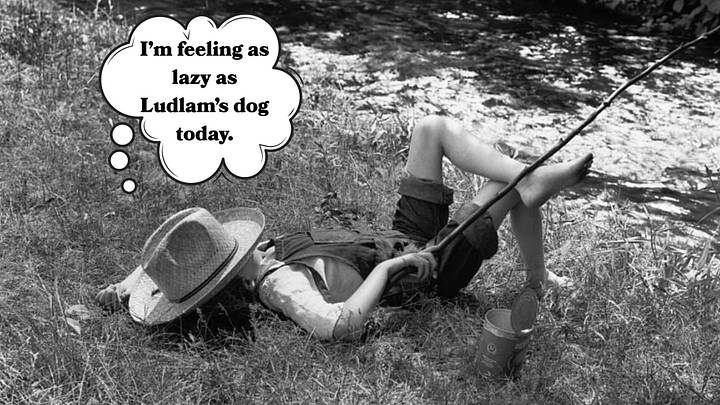
The 18th-century comparison as lazy as Ludlam’s dog drew on folklore about a supposed witch who lived in a cave near Farnham in Surrey, about 30 miles south of London. Her dog, the story went, leaned against the cave wall to bark. When someone actually approached, it couldn’t be bothered to bark at all.
Gert and Daisy owed its meaning to sound rather than to anything its namesakes did. Sisters Elsie and Doris Waters played the popular characters on British radio in the early 1900s. In the 1960s, their names supplied a ready-made rhyme for lazy.