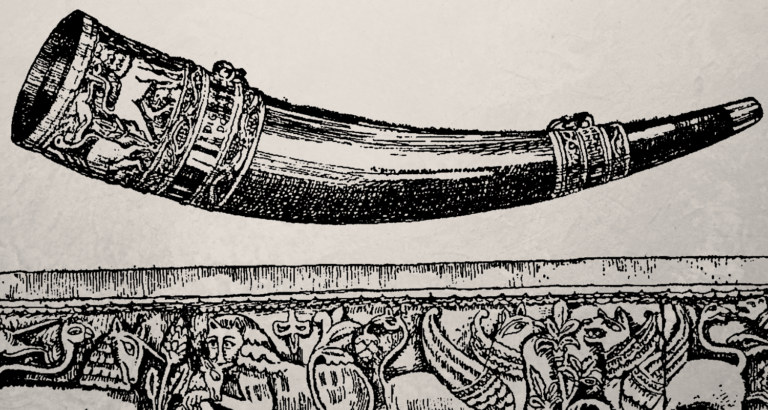
It’s clear from mythology that alcohol was ritually significant in Norse culture, and none more so than mead, which was considered a godly drink and one that imbued the drinker with poetic skill. In the ancient sagas the origin story of mead comes from a daring series of thefts, with the drink first created through the spit-based peace negotiations of two warring god-families. Their congealing spit birthed a mystic with the highest intelligence called Kvasir whose blood was in fact all mead, and through this blood flowed poetry itself. Kvasir was murdered by dwarves for his blood-mead, and then this precious liquid was stolen again by a giant. Odin, king of the gods, wanted his own share and so disguised himself as an eagle and stole the mead from the giant, allegedly seducing the giant’s daughter in the process. As Odin escaped, some of the mead was spilled from his eagle’s beak and fell to earth. It was said that the great Norse saga poets were those folk who by luck were struck by drops of falling mead from Odin’s beak.
Beyond the escapades of the gods, a lot of drinking also happened in the mortal Norse realms. Shared drinking helped keep Norse society together as a way of professing loyalty and signing contracts, from marriage to inheritance. This drinking, along with most other gatherings, would take place in the hall, given the winter weather and limited fuel for fires. It was in these halls that feast-throwing and drinking in honor of a lord or warrior would take place. The feast, a sometimes days- or weeks-long exhibition of power and hospitality by the host, was a common if extraordinarily expensive way of gift-giving and demonstrating respect among the elites of Norse society.
Great halls designed for this purpose would ring with music, played on bone flutes, bells, stringed instruments and rattles, as well as shields beaten as drums. Such music would be accompanied by other entertainment, including dramatic performances of the old sagas. Drinking was such an integral part of these feasting celebrations that some later sagas show those who did not drink being ostracized from the retinue of their host with some hostility, their lack of involvement seen as an affront.
This binding together of drinkers was done through a custom of sumbl, a ritual ceremony also known as “oath cup,” where a woman, often related to the host, would share out a ritual drink among the gathering, one sip at a time and from the same glass. It’s possible women undertook this as a nod to their perceived magical power, and their role as brewers too. The order of those served would help establish the hierarchy of the gathering. In the sagas, this drinking ritual was often accompanied by an oath or vow. In Beowulf, an Anglo-Saxon poem recounting a saga, Queen Wealhtheow is the cupbearer at a sumbl, greeting her husband and king, Horthgar, with drink first before serving others in turn. Beowulf the warrior takes an oath through this ceremony of the bragafull after being challenged by the Queen to rid her hall, the hall of Heorot, of the evil beast that stalks it. Oath-making and oath-keeping could also bind marriages, alliances and other agreements, often with communal drinking as a shared witness.
For those not rich, battle-famous or influential enough to be invited to the great feasts in the chieftain’s hall, drinking took place in the Skytningar, a more informal refectory, essentially a pub, where individuals paid their own dues rather than a host footing the bill for everyone. These places attracted farmers, merchants and townsfolk and tended to have a bad reputation. Foreign merchants were often blamed for the noisy impact of these drinking houses on their surroundings. Snorri’s Olaf’s saga records how between 1067 and 1093 King Óláfr Haraldsson Kyrri was displeased with the “drinking bouts in marketplaces about the land as a consequence of the large number of merchants.” Later Norwegian kings also continued to rail against the drunkenness of the common man, with King Sverrir in 1300 making a speech against the drunkenness of both his people and the troublesome Germans, whose stronger wine could by then be bought at a price equivalent to local ales.
From gods stealing blood-mead from their giant enemies to warrior chieftains feasting, toasting and oath-making in their great halls, Norse society was intertwined with alcohol, often with a rich societal meaning. A range of less formal drinking methods also appear in the form of Norse drinking games. Many sagas tell of drinking competitions, including the game of mannjafnaor at feasts. The game was essentially a bragging match in which men and sometimes women pitted their wits against each other. Often tasked with debating who was the greater warrior, based on athleticism, attractiveness or preeminence in a given district or hall, the debates were quarrelsome and raucous. Such contests could descend into senna, a form of one-on-one competitive insulting before a crowd, often done in exaggerated poetic verse, with horns of ale drunk between verses. In one saga example, three men exchange round after round of senna: the king’s men listen, they take Oddr the horns and he quaffs them both, and afterward Oddr rises and finds they are conquered by the drink and beyond composing poetry.
Hnùtukast was another drinking game, probably left to the end of the evening, requiring none of the boasting or insults of mannjafnaor or senna. Guests would take bones left over from the meal and, agreeing on a series of targets that did not necessarily exclude living ones, take turns launching them, with the least successful receiving a forfeit, perhaps more drinking. Other games in the sagas left by Norse skald poets include swimming competitions, testing duels, and contests to see who could hold their head longest under water in a barrel. Almost anything in a hall full of ale-addled men could become a drinking game.