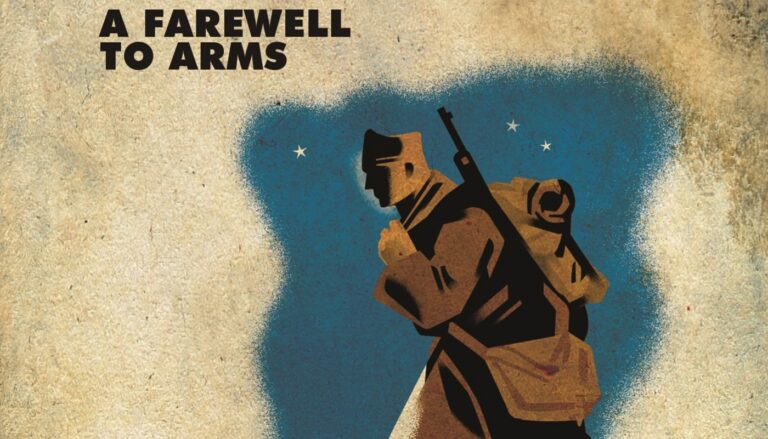
In May 1929, Scribner’s Magazine began serializing Ernest Hemingway’s new novel A Farewell to Arms after removing language the young author wanted to keep. In Four-Letter Nation, Steven H. Jaffe writes that the magazine cut “shit,” “fuck,” “balls,” “cocksucker,” “son of a bitch,” “whore,” and “Jesus Christ.” The semi-autobiographical novel follows an American ambulance driver on the Italian front in World War I.
For publication as a book, Maxwell Perkins, Hemingway’s editor at Charles Scribner’s Sons, got the last three of those expressions restored, in lines such as “I shot the son of a bitch with my rifle,” a sentence about loading women from the soldiers’ whorehouse into a truck, and “Jesus Christ what I could do with two hundred and fifty dollars.” Perkins conceded “scrotum” instead of “balls,” but refused an abbreviated substitute for “cocksucker,” which became a dashed line: “I killed that – of a sergeant.” Hemingway had to turn other four-letter words into evasions such as “Go something yourself.”
Hemingway protested that “emasculation was a minor operation to perform on men, animals, and books, but its effect was great,” and said he was fighting for “full use of the language.” He gave in, having won only part of the argument.
What remained was still too much for officials in some places. “Scrotum,” “son of a bitch,” “whore,” “Jesus Christ” used as an exclamation, and the novel’s premarital love affair drew objections. In Boston, already known for banning literature and art that officials deemed indecent, Police Superintendent Michael Crowley announced that the June issue of Scribner’s was barred from sale because of its “salacious” material, even before the book restored some of the words.
Scribner’s defended Hemingway in a press release as “one of the finest and most highly regarded of the modern writers” and said it would continue the serialization. It also called the novel “distinctly moral”: “It is the story of a fine and faithful love, born, it is true, out of physical desire.” The release added that if white was to be contrasted with black, “the picture cannot be all white.”
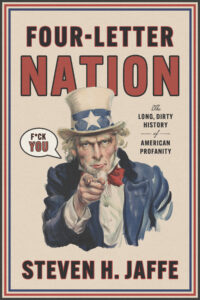
Jaffe argues that this defense avoided a point Hemingway, an admirer of Mark Twain, would have rejected: a simple black-and-white moral as an evasion of harder values. The release went out anyway, and the publisher’s investment paid off. A Farewell to Arms sold 31,000 copies in its first print run and helped make Hemingway financially independent. As book-industry executives expected, being “banned in Boston” probably boosted sales, including among Bostonians who could cross the city line and buy copies elsewhere.
One passage in the novel reverses ordinary ideas of what counted as obscene. After an Italian soldier says the deaths in a recent offensive cannot have been “in vain,” the American protagonist, Frederic Henry, reflects that words such as sacred, glorious, sacrifice, glory, honor, courage, and hallow embarrassed him. Set beside the concrete names of villages, roads, rivers, and regiments, and beside dates, those abstractions seemed obscene. Jaffe’s reading is that spare, truthful words—including honest profanity—had dignity, while grand phrases were obscene because they evaded hard truths. In that view, “fuck,” “shit,” and “cocksucker” could register real speech, while “glory,” “honor,” and “courage” could delude.
The dispute was also fought inside the Manhattan offices of Charles Scribner’s Sons. Jaffe describes Scribner’s and other prestige presses as their own word police, upholding nineteenth-century aesthetic and moral ideals while selling books and magazines. Perkins had already been through similar objections. In 1922, older editors opposed another of his authors, F. Scott Fitzgerald, when Fitzgerald wanted to title a story collection Tales of the Jazz Age. Perkins explained that they felt “the word whatever implication it actually has, will itself injure the book.” The title stayed. Fitzgerald predicted that it would be bought by “the countless flappers and college kids who think I am a sort of oracle.” Jaffe notes that many of those readers knew jazz’s implications could include semen, orgasm, and sex.
Hemingway’s first novel, The Sun Also Rises, had nearly been rejected by Scribner’s in 1926 despite Perkins’s advocacy. Its spare account of rootless young Americans in post–World War I Europe bewildered older editors, and Hemingway and Perkins fought to retain “bitch” as a description of Lady Brett Ashley. As another writer observed, old Charles Scribner “would no sooner allow profanity in one of his books than he would invite friends to use his parlor as a toilet room.” The company agreed to publish only with great reluctance and expected a Boston ban. The novel sold quickly; by Hemingway’s death in 1961, an estimated million copies had circulated.
Writing of the 1920s, the critic Edmund Wilson said, “The great watchword was ‘Have a drink’; and in the bars of New York and Paris the young people were getting to talk like Hemingway.” Decades later, John Updike reflected that “an entire generation of American men learned to speak in the accents of [his] stoicism.”