On November 24, 2026, people in the Indian state of Odisha marked Boita Bandāṇa by setting small boats afloat, a custom recalling merchants who sailed toward Southeast Asia. A proposed voyage by the Indian naval sailing vessel INSV Kaundinya would follow that maritime theme: in February 2026, economist and project advocate Sanjeev Sanyal described a plan for the vessel to sail from India’s east coast to Bali around the November full moon. It was a plan, not a completed voyage.
The vessel’s name points to a much older question: who was the seafarer remembered as Kauṇḍinya, and what do the surviving records actually say?
A name assembled from different accounts
Sanyal has described Kauṇḍinya as the first named Indian voyager to Southeast Asia. The earliest surviving Chinese-language account of the relevant journey, however, names its protagonist Hun Shen; later histories write his name with different second characters, including the form often rendered Hun Tian. In the story, he receives a divine bow, boards a merchant ship, reaches Funan—roughly in the area of southern Cambodia and the Mekong Delta—and subdues a local queen named Liuye. The accounts do not name the ship’s owner or crew, establish that the traveller came from India, or call him Kauṇḍinya.
The name Kauṇḍinya appears elsewhere in Chinese histories in connection with a later Funan ruler, described in the Book of Liang as a Brahmin originally from India. A Sanskrit inscription from Mỹ Sơn, erected in 658, tells a different story of a Brahmin Kauṇḍinya marrying Somā, a serpent king’s daughter. It does not mention the merchant ship, divine bow, Hun Tian or Liuye. Kauṇḍinya was also a Brahmin lineage name, not necessarily the name of just one person.
Beginning with Paul Pelliot’s work in the early 20th century, scholars brought these accounts together. George Cœdès treated the bow-bearing traveller as an earlier Kauṇḍinya, while later researchers challenged that identification. Michael Vickery argued that the name cannot be recovered from the early Chinese transcriptions; William Southworth wrote in 2024 that the familiar story combines material from different periods. The traveller’s place of origin remains unresolved.
Evidence of contact is firmer than the proposed identification. A study published in 2022 reported that the remains of a boy buried at Angkor Borei, dated to between 78 and 234 CE, showed substantial South Asian ancestry. One burial cannot establish who founded Funan’s ruling house, but it does attest to connections between South Asia and the region.
A vessel built to revisit a maritime past
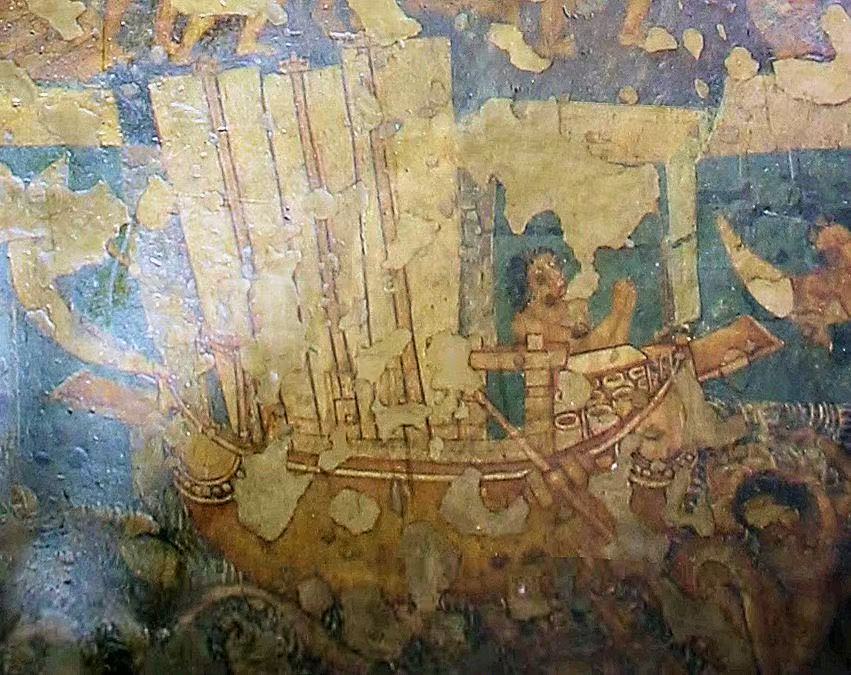
INSV Kaundinya was built with planks sewn together using coconut-fibre rope rather than iron nails, drawing in part on a fifth-century ship image at Ajanta. It was launched in February 2025 and sailed from Porbandar, India, on December 29 that year, reaching Muscat, Oman, on January 14, 2026. Chinese-language writings also describe sewn vessels in southern maritime trade, though they offer no surviving plan for the ship in Funan’s founding story.
The modern vessel can make that history visible. Its name, however, reflects a contested reading of sources—not a confirmed identity for the traveller who boarded the merchant ship.