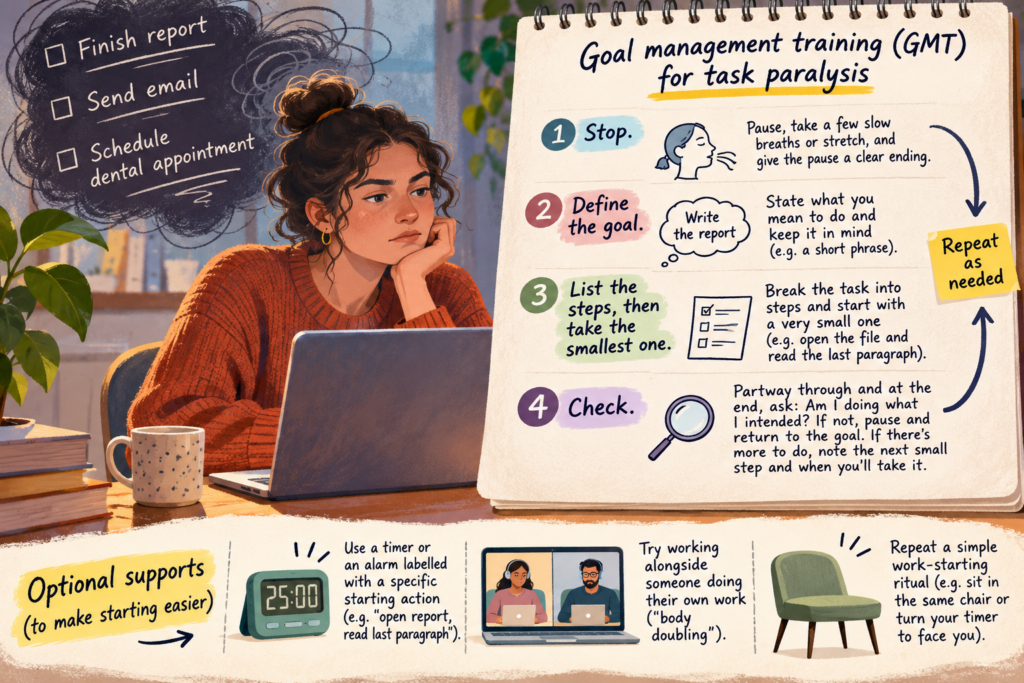
You may want to finish a report or send an email, have time set aside to do it, and still find yourself unable to begin. In a guide published on 20 October 2026, a therapist who works with adults with attention-deficit/hyperactivity disorder (ADHD) describes this as task paralysis: difficulty starting something you intend to do, rather than choosing to put it off. The guide notes that it can also occur without ADHD, particularly under stress or after too little sleep.
The therapist recommends a sequence drawn from goal management training (GMT), an approach first developed in the 1990s by psychologist Ian Robertson for people recovering from brain injury and later refined with neuroscientist Brian Levine. The four stages can be repeated whenever you lose track of the task:
- Stop. Pause before trying to push through. Take a few slow breaths or stretch, and give the pause a clear ending so it does not become an extended break.
- Define the goal. State what you mean to do and keep bringing it back to mind. A short phrase can help when an interruption pulls your attention elsewhere.
- List the steps, then take the smallest one. If “write the report” feels too large, try opening the file and reading the last paragraph. The first step should be small enough to begin without committing to the whole task at once.
- Check. Partway through and at the end of a work period, ask whether you are doing what you intended. If not, pause and return to the goal. If work remains, write down the next small step and when you plan to take it.
The guide adds three optional supports: use a timer or an alarm labelled with a specific starting action; try working alongside someone who is doing their own work, sometimes called body doubling; and repeat a simple work-starting ritual, such as sitting in the same chair or turning a timer to face you. These are suggestions for making a start easier, not a requirement to use every technique at once.