On September 4, 2001, wildlife artist Rob Mullen painted the east bank of Ontario’s Missinaibi River while his dinner boiled at the Kettle Falls portage. His acrylic field painting, The Way North – Kettle Falls, Missinaibi River, caught the evening light. What it could not show, Mullen recalls, was how lonely he had been when he picked up his brush, or why, only minutes later, he felt close to other people despite being alone. For that part of the evening, he had a journal.
Mullen had set out to paint, not to become a writer. In 1994, he left a career in New York City advertising and returned to his home state of Vermont to pursue wildlife art. Six years on the national art show circuit followed. At a show in the winter of 2000–01, he realized how much of his working life he spent hauling art and how little time he had with the subjects that made him want to paint. He cleared his late-summer schedule for a 330-mile canoe trip down the Missinaibi toward James Bay.
Two magazines took an interest: an art publication wanted to hear about a painter traveling by canoe, while a canoeing magazine liked the idea of a paddler traveling to paint. They asked Mullen to keep a journal. Fellow wildlife artist John Pitcher joined him for the first 130 miles, then had to turn back at Mattice, Ontario. Mullen faced the remaining 200 miles through roadless country alone.
Kettle Falls was his first camp after they parted. Setting up camp and starting dinner did little to ease his loneliness. Painting was meant to be another distraction, but the fading light required him to work quickly. As the image took shape, he recalls, his melancholy gave way to elation and an unexpected feeling of kinship with people. He says the loneliness never returned on the river. Writing up the day that evening, he found he had something to record beyond where he had paddled and what he had seen.
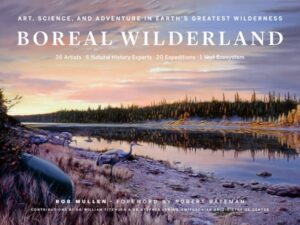
Back home, Mullen learned that the northern rivers he had traveled belonged to the boreal forest, the world’s largest terrestrial biome. Writing became as important as painting in his subsequent decades of work with artists, scientists, conservation organizations and Indigenous communities to draw attention to the forest. For Mullen, author of Boreal Wilderland: Art, Science, and Adventure in Earth’s Greatest Wilderness, the value of these places does not depend on how many people visit them. Even for rivers he may never paddle again, he finds comfort in knowing that someone can still put a canoe in the water and see what the map describes.