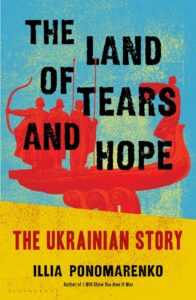
At Kruty, a railway stop beyond Nizhyn, a dark red column stands on black stone. Its colors are those of the old Kyiv University. In The Land of Tears and Hope: The Ukrainian Story, Illia Ponomarenko recounts how students, cadets and schoolboys came to defend the station in January 1918, and how the memory of their battle survived largely in émigré memoirs for a century.
The Ukrainian Central Rada had declared the independence of the Ukrainian People’s Republic only days before the battle. As Bolshevik forces advanced by rail toward Kyiv, the republic also faced an armed uprising at the capital’s Arsenal factory. At Brest-Litovsk, Ukrainian delegates were seeking recognition of the republic and help against the Bolsheviks, offering food in return. At Kruty, commander Averkiy Honcharenko received word that no reinforcements would come: troops were needed in Kyiv, and the militia in nearby Nizhyn had sided with the Bolsheviks.
Ponomarenko reconstructs the retreat through the experience of Matviy Danyliuk, a cadet from Volhynia who reached the waiting train. One platoon did not. In Ponomarenko’s account, 27 students and schoolboys lost their way in the fog and returned to the station, where Bolshevik forces captured and shot them. Villagers later buried them. Ponomarenko distinguishes a story passed down about their last moments from the account of their deaths: Hryshko Pipskyi is said to have begun singing the Ukrainian anthem, and the others to have joined him.
Danyliuk lived until 1994. He died at 103, the only Kruty veteran known to have lived to see an independent Ukraine. Twenty years after his death, his great-grandson Volodymyr Ishchuk was killed near Ilovaisk in Donbas. Ponomarenko writes that Ishchuk was among hundreds of Ukrainian volunteers ambushed by Russian troops wearing no insignia in 2014.
Under Soviet rule, Danyliuk used to greet people jokingly with Slava Ukraini!—“Glory to Ukraine!”—to his relatives’ unease. Ponomarenko traces the greeting to the years of the republic, when it could be heard at rallies and among marching volunteers. There was no single customary reply. Other symbols of the republic survive in photographs and newsreels: yellow-and-blue flags above Kyiv crowds, a trident on a standard and armbands bearing the republic’s initials.
Ukrainian radical nationalist underground movements used the greeting in the 1940s. Russian war propaganda has portrayed it as a Nazi slogan, a characterization Ponomarenko disputes by pointing to its earlier use. He describes how the greeting, now commonly answered with Heroyam Slava!—“Glory to the Heroes!”—returned to widespread use during Ukraine’s revolutions and Russia’s full-scale invasion. He closes with one instance from the final days of 2022: the Ukrainian soldier Oleksandr Matsievsky said “Slava Ukraini!” before Russian soldiers shot him in Donbas.