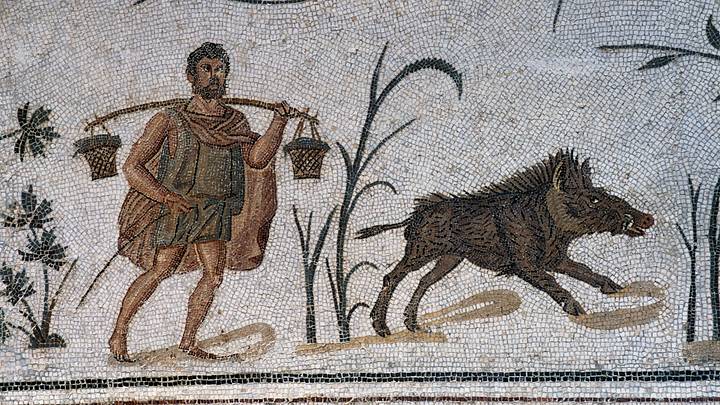
For much of Roman history, the most common place to work was a farm. In Rome’s early years, most farmers worked their own land, and families usually baked their own bread. By the second century BCE, many farmers were losing their land, while in cities, bakers were turning what had been a household task into a trade. Who did the work, and under what conditions, varied across the 1,228 years from Rome’s founding in 753 BCE to the fall of the Western Roman Empire in 476 CE.
Farming: family plots and large estates
Some estimates put the share of Roman society working in agriculture as high as 80 to 90 percent. Farmers chose soil, plowed and sowed fields, and tended crops including grain, olives and grapes. Most farms also kept livestock. Cows supplied milk, sheep and goats provided wool, cheese and meat, and oxen did heavy work in the fields.
Romans generally regarded farming as honorable, but working the land did not always mean owning it. Most farms were family-owned until around the second century BCE, when wealthy landowners began displacing large numbers of plebeian farmers. Enslaved people worked the large estates, and many farmers who had lost their land moved to the city.
Baking: from the household to the commercial oven
Around the second century BCE, baking techniques spread from Greece to Rome, and commercial bakeries became more common in Roman cities. Archaeologists have identified 35 bakeries in Pompeii alone.
A bakery typically housed both grain mills and large ovens. Donkeys powered the mills, and bakers kept the ovens firing throughout the day. In later Roman times, the people who ran commercial bakeries typically belonged to a formal bakers’ guild, the corpus pistorum.
Shopkeeping: goods and services at street level
Rome drew newcomers from far beyond the city during the last two centuries BCE, and its markets flourished. Street-facing shops known as tabernae served customers across social classes. Poorer residents could buy prepared meals rather than spend time cooking at home. A single shop might offer several services, from repairing shoes and clothes to packaging goods or making pottery. Booksellers, apothecaries and bankers also worked from storefronts.
Behind a counter might be a freeborn citizen, a formerly enslaved person or an enslaved person working for an owner. Some elite Romans valued landownership and political or military service more highly than commerce. For those outside the elite, however, selling goods was a relatively dependable way to earn a living in the city.
Building: skilled trades, hired hands and military labor
Rome’s aqueducts, roads, bridges and domed buildings drew on the work of architects, engineers and tradespeople. Stonemasons and fresco painters contributed specialized skills; the workforce also included hired laborers, soldiers and enslaved people.
Estimates for a project such as the Pantheon put the daily workforce at 100 to 240 men. Road and bridge building also fell to military legions, which could number up to 5,000 men. For those soldiers, construction was part of their duties alongside campaigning, rather than a separate civilian trade.