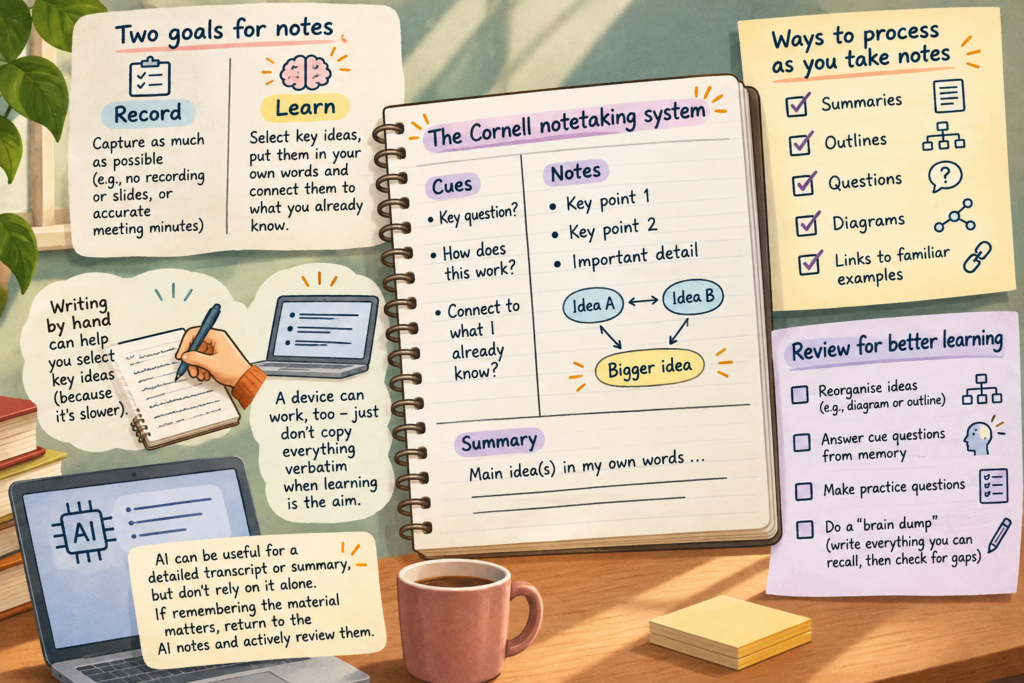
A guide published on 5 November 2026 draws a distinction between two reasons for taking notes: keeping a record and learning from the material. If a lecture has no recording or slides, or if you need accurate meeting minutes, capturing as much as possible may be the priority. But when the goal is to understand and remember, the guide recommends selecting important ideas, putting them in your own words and connecting them to what you already know.
Writing by hand can help with that selection because it is slower than typing, the guide explains. Paper also makes it easy to draw connections between ideas. A device can work, too: the key is not to copy everything verbatim when learning is the aim. Summaries, outlines, questions, diagrams and links to familiar examples all give you ways to process the material as you take notes.
One structured option is the Cornell notetaking system, developed by Cornell University education professor Walter Pauk. Divide a page into a main area for notes, a left margin for cues and a space at the bottom for a summary. Record key points in the main area; afterward, add questions or prompts in the margin that you can use to test your recall. Use the bottom section to summarise the larger ideas in your own words. If you first need to capture a dense lecture in detail, you can organise those initial notes into this format later.
Review matters as much as the first round of notes. Rather than only rereading or copying them, try reorganising the ideas into a diagram or outline. Then answer your cue questions from memory, make practice questions or write down everything you can recall before checking your notes for gaps. These approaches help reveal what you have and have not understood.
AI tools can be useful when you need a detailed transcript or summary, the guide says. But relying on them alone skips the processing involved in taking your own notes. If remembering the material matters, return to any AI-generated record and actively review it.