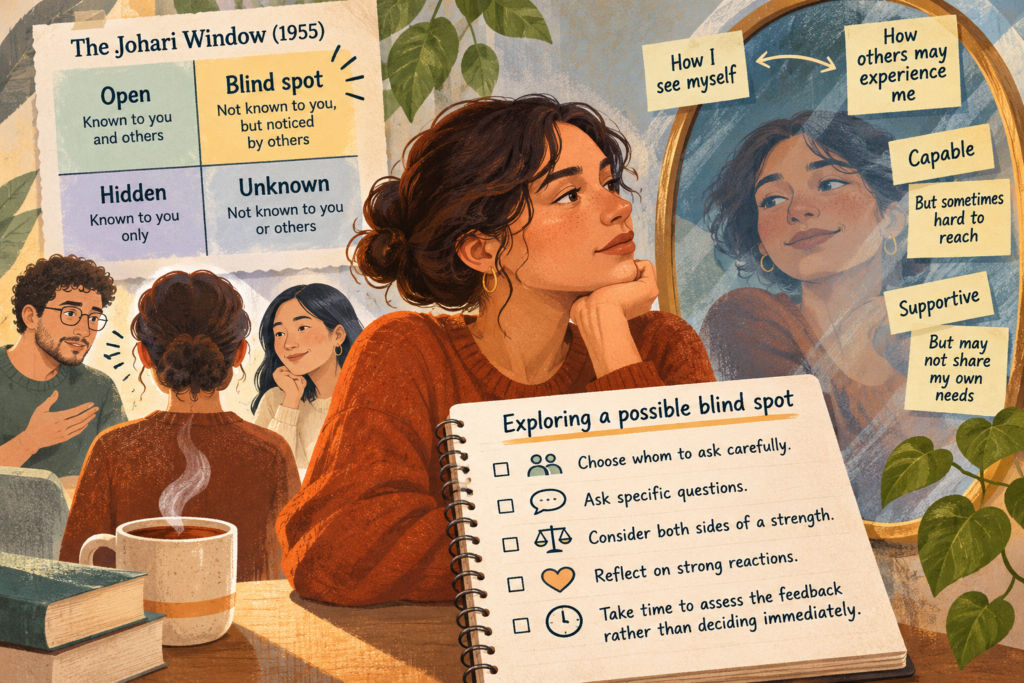
Feedback can be unsettling when it reveals a gap between how you see yourself and how others experience you. In a guide published on 14 September 2026, a psychologist describes these gaps as potential “blind spots”—while cautioning that another person’s view is not automatically accurate.
The guide uses the Johari Window, introduced by psychologists Joseph Luft and Harrington Ingham in 1955, to explain the idea. One part of the model covers qualities that others notice but you do not. Because people see their own intentions from the inside and encounter others’ behaviour from the outside, those perspectives may differ.
To explore a possible blind spot, the guide suggests:
- Choose whom to ask carefully. Someone who knows you well and treats you with care may offer more useful observations than someone who is hurtful or unpredictable.
- Ask specific questions. You might ask which two or three traits a trusted person associates with you, or what they find easiest and hardest about their relationship with you.
- Consider both sides of a strength. A quality you value in yourself may also create difficulties in some situations.
- Reflect on strong reactions. If your response to an event seems unusually intense, consider what feelings or worries might be involved rather than assuming a single explanation.
The psychologist advises taking time to assess feedback rather than accepting or rejecting it immediately. Consider whether trusted people have made similar observations, look at your own behaviour, and distinguish the effect you had from what you intended. The aim is not to become whoever others want you to be, but to decide whether an observation helps you understand yourself—and whether you want to change anything.